Health & safety
The Delta will not
hide this from you
A warm, standing, freshwater swamp inside the tropics is the two things that malaria and bilharzia need in one place. Most guides bury both in a paragraph. Here they are the page.
Per the CDC Botswana guidance current as of 2026-09-25.
Malaria: an answer by district, not by shrug
Most destination health advice says “certain areas” and leaves you to guess which ones. The CDC does something better for Botswana: it names the districts. That matters for the Okavango, because your answer changes depending on which part of the country you spend time in — and because a Delta camp and a Gaborone hotel are not the same malaria question.
The Delta sits inside the transmission group, along with Chobe, Ngamiland and most northern safari country. The parasite is mainly Plasmodium falciparum, with P. malariae, P. ovale and less commonly P. vivax also present. Chloroquine resistance means the old first-line drug is no longer useful here, which is why the current list matters.
| Where | Status | What applies |
|---|---|---|
| Okavango, Ngamiland, Chobe, North-East, Ghanzi, Bobirwa, Boteti, Mahalapye, Serowe/Palapye, Tutume | Transmission | Take antimalarial prophylaxis. This is the group the Okavango Delta belongs to. |
| Kgalagadi North, Kgatleng, Kweneng, Southern | Rare cases or sporadic foci | No chemoprophylaxis recommended. Insect-bite precautions only — a genuinely different answer from most African destinations. |
| Gaborone (the capital) | No transmission | Nothing to take. This is why a Gaborone–Maun flight can change the answer to your malaria question. |
Transmission grouping per the CDC Botswana traveller guidance, updated April 2025. Season shifts the level of risk but not the grouping.
The practical version: bring the list of camps, lodges and towns you will actually visit to your travel doctor, not the word “Botswana”. Two districts apart can carry opposite recommendations.
The four drugs, and the timing that catches people out
Which drug you should take is a prescription decision involving your medical history and the interactions with everything else you take. What is worth knowing in advance is that the start dates differ by weeks. Mefloquine has to be running before you fly, and the commonest way a course fails is not the drug but the three-week run-up skipped because the flight was booked late.
| Drug | Start | After you leave | What to know |
|---|---|---|---|
| Atovaquone–proguanil | 1–2 days before | 7 days after leaving | The usual first choice. Short run-up, and the easiest schedule to actually follow. |
| Doxycycline | 1–2 days before | 4 weeks after | A daily antibiotic. Sun sensitivity — worth knowing at latitude 19°S. |
| Mefloquine | 2–3 weeks before | 4 weeks after | Weekly. The long run-up is what people miss, and stopping early is what fails. |
| Tafenoquine | As prescribed | As prescribed | Single-dose course in most schedules. Requires G6PD testing first. |
Finish the post-travel course even if you feel entirely well. Malaria has a long runway, and an incomplete course is a way of arranging to get sick at home.
Drugs first, then the parts that are not medical. Anopheles mosquitoes here feed at dusk and through the night, so the measures that work are the ones you keep to: DEET-based repellent reapplied through the day, long sleeves and trousers at dawn and dusk, an intact treated net over the bed, and permethrin-treated clothing. Prophylaxis is not a substitute for any of it.
The one that is not malaria: bilharzia
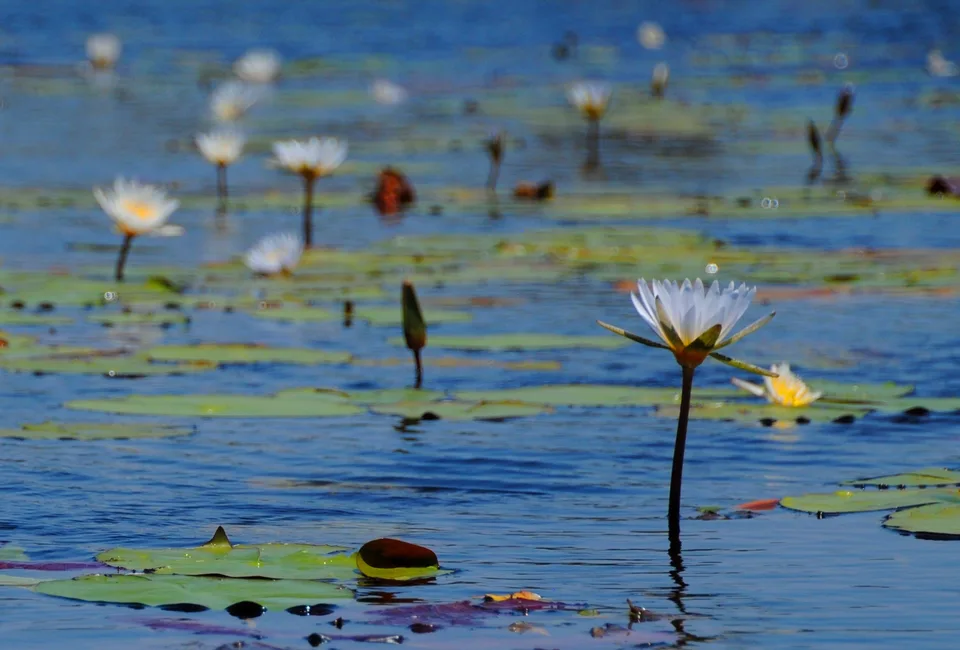
Mokoro is a very quiet way to put your arms, legs and lower body into warm freshwater for an hour. It is also, on a specific and well-documented map, an exposure to a parasite. Schistosomiasis — bilharzia — is transmitted by freshwater snails, and the larvae penetrate skin that has touched contaminated water.
In Botswana the picture is local: Schistosoma mansoni is present in the North-West District, particularly along the Okavango River and its marshlands and in the villages along the Chobe River, while S. mansoni and S. haematobium are reported in the Limpopo valley. Among the places where localised risk has been reported are Maun, Kavimba, Kasane and Pandamatenga — which is to say the places a Delta trip actually touches. The Kalahari districts of Kgalagadi and Ghanzi are rated free of risk.
Most infections produce no obvious symptoms, which is precisely what makes them easy to file under nothing. Where symptoms come, an itchy rash appears where the larvae entered; between four and eight weeks later a fever, cough, diarrhoea or muscle aches can follow. Untreated, the eggs damage the bladder, kidneys, bowel or liver over years, and the damage is not reversible. Praziquantel is an effective treatment.
The one piece of advice that saves people the most trouble: get assessed no sooner than two months after you come out of the water. Not a fortnight. The parasite cannot be reliably detected earlier than that, so testing too soon returns a false negative, the traveller concludes they are fine, and years later something gets found. It is not a reason to skip mokoro — it is a reason to put a two-month note in your diary and go and be seen.
The certificate that catches people out
Yellow fever is not a Botswana risk — the vaccine is not recommended for travellers coming directly from countries with no transmission. The entry rule is about arrival, and it is applied at the border by Port Health at Maun and Kasane just as much as at Gaborone.
If you arrive from a country where yellow fever is transmitted — or you transit one for more than twelve hours, including inside the transit zone — you must be able to produce an international certificate of vaccination. Three details make this a pre-departure chore rather than an airport problem: the vaccine needs ten days to become effective, it must be issued by an approved travel clinic rather than an ordinary doctor’s surgery, and it is a physical yellow card. Photocopies and phone photographs are not accepted.
Beyond that, the recommended vaccines are unglamorous and worth doing: hepatitis A for most travellers, typhoid for longer stays and rural areas, hepatitis B and rabies where there is blood, body-fluid or animal contact, and routine checks on MMR, polio and tetanus-diphtheria. Book the travel clinic four to six weeks out — vaccines with a run-up need the calendar, and the difference between a rushed appointment and a useful one is bringing your itinerary.
If something goes wrong: how the evacuation chain actually works
This is the part of a Delta trip worth understanding before you are in it. A premium camp on an island concession is reached by light aircraft, has a small permanent staff and the nearest advanced hospital is a fixed-wing flight away in Maun. Botswana’s health system is good in the towns and much thinner in the bush, and the sentence that governs everything else is the one that follows it: seriously ill travellers are likely to need medical evacuation.
For the Delta and the Kalahari, that evacuation is usually Okavango Air Rescue. It is the only helicopter rescue service operating in those wilderness areas with medical staff aboard, which is a much narrower claim than “air ambulance in Africa” and the reason it exists at all. In 2024 it flew an average of five rescues a month at roughly USD 3,000 per mission, and the operating model is a patronage membership rather than fee-for-service — the Swiss REGA model — because an operation like that cannot be funded by the calls it answers.
Here is the part most insurance pages will not tell you. OAR’s own position is that holding insurance does not by itself guarantee access to the helicopter and the medical team. Access is arranged through membership, and in practice some camp and lodge groups enrol their guests automatically as part of the rate while others expect you to arrange it. So the questions are specific: does my policy name medical evacuation and hospital treatment, does it pay the facility directly or reimburse me afterwards, and has the camp confirmed that its guests are covered with this particular operator this season?
Botswana also expects private facilities to ask for proof of insurance or immediate payment in cash, so carry the policy number somewhere you can read it without a signal. And ask the camp, not the agent — with a light-aircraft transfer involved, the answer to “how long until I am in a hospital?” is a fact about that property, not about the country.
What actually goes wrong, in rough order of frequency
Malaria and bilharzia dominate the health advice because they are the two diseases you cannot self-diagnose from a bed in a camp. The rest is ordinary and preventable, and the list below is the one worth reading on the plane.
Traveller’s diarrhoea and typhoid come from water and food, so the rule is bottled or boiled water including for brushing your teeth, and a preference for things cooked in front of you. Leptospirosis comes from contact with urine-contaminated water or mud, which in a flooded delta is worth bearing in mind — avoid wading through standing water you cannot see the bottom of. Dengue and African tick-bite fever come from bites, so the same repellent discipline covers them. Ticks are real after a day in long grass; do a check in the evening.
Then the road. Driving after dark is named as a cause of fatal accidents in Botswana, because the animals are on the road and the game-viewing vehicle is not the thing that moves fastest at night. Everything else follows from that: no walking or driving at night in ways your camp has not authorised, no touching or feeding animals, and a wound treated properly and promptly rather than left dirty. There is no chemprophylaxis or vaccine for any of this — it is the behaviour that does the work.
Questions people ask about health here
Do I need malaria tablets for the Okavango Delta?
Yes. The Delta is a warm, standing freshwater swamp in the tropics and sits inside the group of Botswana districts where CDC recommends chemoprophylaxis. Risk is highest during and just after the wet season, but it does not drop to zero in winter. Take the drug exactly as prescribed and finish the post-travel course.
Which malaria drug should I ask for?
That is a prescription decision, not a travel article decision. CDC lists atovaquone-proguanil, doxycycline, mefloquine and tafenoquine for this district group, with atovaquone-proguanil the usual first choice because it needs only a one or two day run-up. Bring the specific camps and dates to your travel doctor — the answer depends on your itinerary, your medical history and the drug interactions, not on which country you are visiting.
Do I need a yellow fever certificate to enter Botswana?
Only if you arrive from, or transit through, a country where yellow fever is transmitted — and the transit rule catches more people than expected. A stop of more than twelve hours in an airport in an affected country, even inside the transit zone, counts. The vaccine takes ten days to become effective, and the certificate is a physical yellow card: a photo of it on your phone is not accepted at the border.
Which vaccines are worth having before a Delta trip?
Hepatitis A is recommended for most travellers. Typhoid is recommended if you are away a long time or visiting rural areas, and both hepatitis B and rabies are recommended for longer stays, repeat visits or anything that involves contact with animals. Check that routine vaccines are current, including MMR — measles cases are rising in many countries and Botswana is not exempt.
Can I swim or paddle in the Delta?
Mokoro is a skin-in-the-water activity by definition, so the honest answer is to know the specific risk rather than be told not to go out. Schistosomiasis, or bilharzia, is present in the Okavango River and its marshlands, and Maun, Kavimba, Kasane and Pandamatenga are listed among the places where local risk has been reported. If you have been in the water, get yourself assessed no sooner than two months after you get out — testing before that will not conclusive.
How far is a hospital from a Delta camp?
For most camps, hours rather than minutes. The nearest advanced facilities are in Maun, then Gaborone, and for anything requiring a tertiary hospital the usual destination is Johannesburg. That distance is the entire reason medical evacuation cover matters more here than anywhere else on a typical safari circuit.
Does my travel insurance cover medical evacuation from the Delta?
It depends, and the gap is worth checking before you fly rather than after. Okavango Air Rescue says plainly that insurance coverage does not automatically guarantee access to their helicopter and medical teams. Some camp groups enrol their guests automatically; others require you to join. Ask the camp directly, and ask whether the policy pays the facility or reimburses you afterwards.
Should I worry about wild animals while I am in camp?
The failures are mostly procedural rather than dramatic. Do not drive at night — animals on the road are a named cause of fatal accidents here. Do not touch or feed animals you do not know, and treat the walk back to your tent as part of the park, because the wilderness is not fenced. Elephants walk through Kasane; that is normal, not an incident.
Related reading