Hydrology
The flood arrives
in the dry season
Rain falls in Angola around January and takes six months to arrive. What reaches the Delta in June is the reason a wetland the size of a small country exists in the middle of the Kalahari — and the reason it holds animals when everything around it has dried out.
Indicative season and stage data as of 2026-09-25.
Where the water comes from
The Delta shows up on maps as a fan of channels on the edge of the Kalahari. What fills it has nothing to do with the rain that falls on Botswana. It arrives from the Angolan highlands, where mean annual rainfall is roughly 1,000–1,300 mm — about three times what the Delta itself receives. Most of that falls between November and March, as heavy convective storms.
Around 11 cubic kilometres of water enters the Delta each year. That is the whole supply. It is not a river with a mouth; it is a river that stops, and every drop of it ends up in a plant, in the air, in the sands, or in Lake Ngami.
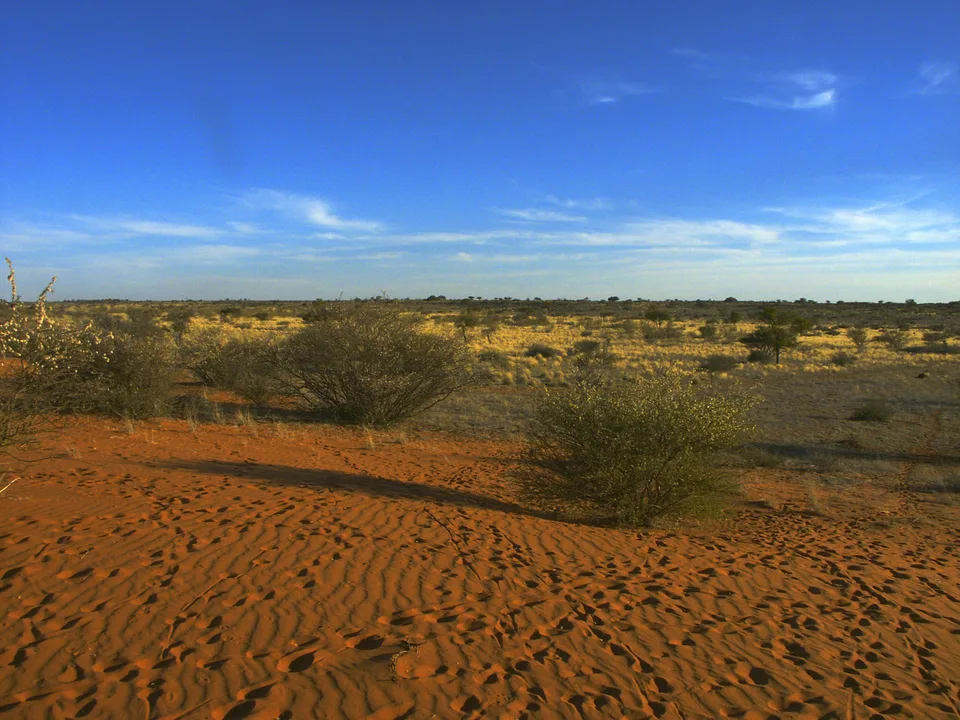
Nothing here drains to a sea. That single fact shapes the ecology, the salt islands and the animal movements you will see.
The 1,200-kilometre journey
The flood that reaches the Delta is not a surge of water chasing itself down a channel. It is a wave. Once the Angolan catchment is saturated, the front travels roughly 1,200 kilometres in about a month, moving slowly enough that the Delta is still filling four months after it passes the border.
It enters through the Panhandle, the narrow neck of permanent river where the water is deep and year-round, then branches out over the fan. The Boro is the main channel through the western and central Delta. The Thamalakane carries what leaves the northern floodplain south towards Lake Ngami.
By the time the flood peaks between June and August, the inundated area is close to three times the permanent size of the Delta. Around 70% of the islands that make the Delta such a maze of water and land began life as termite mounds, which rise just enough above the flood to let a tree take root. Chief’s Island — the largest, uplifted by a fault line roughly 70 km long and 15 km wide — is the clearest example of land that the flood makes into a refuge rather than a hazard.
Why it arrives when everything else has dried out
The lag between Angolan rain and Botswana flood is what makes the Delta work. The rain falls in January, the front enters Botswana by around March, and the water peaks in June — the middle of a dry winter that regularly drops below freezing on clear nights.
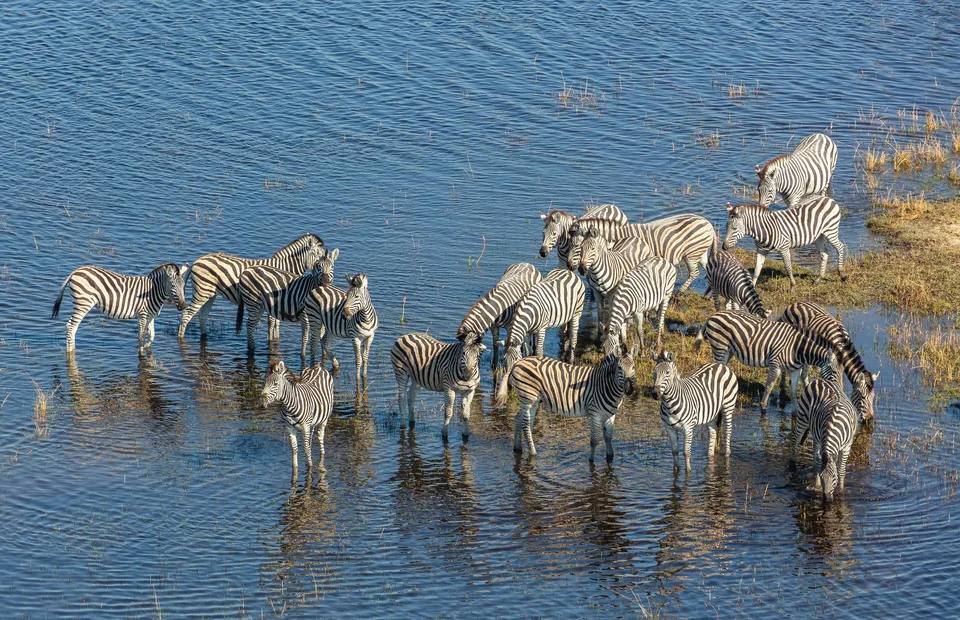
At that moment the surrounding Kalahari is at its driest and the Delta is at its fullest, and the animals do what any animal does: they come to the water. Buffalo, elephant, red lechwe and zebra converge from hundreds of kilometres away, and the predators follow. This is not the rainy season drawing animals together. The point of the flooding is that it happens when nothing else has water.
Where the water goes
An endorheic basin with no outlet loses its water to the air and to plants, which is why the flood never flushes the minerals the river has carried since Angola. The salt that remains accumulates at the centre of the islands, killing the vegetation in white patches and leaving the odd salt-tolerant palm on what is effectively a mound of salt and termite earth.
| Where it goes | Share | What that produces |
|---|---|---|
| Transpired by plants | ~60% | Reeds and papyrus use most of it. This is why the Delta looks green in the middle of a drought. |
| Evaporated | ~36% | Lost to the air. The Delta sits at under 1,000 m and cooks, so water leaves fast once it arrives. |
| Percolated into the sands | ~2% | Soaks into the Kalahari sands and recharges groundwater that wells and roots reach later. |
| Outflow to Lake Ngami | ~2% | The only measurable escape. A river that leaves by evaporation cannot flush its minerals out. |
Share of the annual inflow. The split moves in wetter and drier years.
What the cycle does to your trip
The flood is not one moment you can book around. It is a moving edge, and where you choose to stand relative to it decides what your trip looks like. The table below is the pattern, not a forecast — upstream rainfall varies, so the dates shift by a few weeks either side in any given year.
| Stage | Months | Water | What it means for you |
|---|---|---|---|
| Low | Nov – Feb | Shrinking pools, permanent channels only. Rain in the Delta adds water locally, but not much of it. | Birding at its best, the cheapest rates, and mud on the roads in Moremi. Mokoro runs in the deep channels only. |
| Rising | Mar – May | The flood front works south through the Panhandle and out onto the fan. Water arrives where it was absent three months earlier. | The shoulder season: animals start concentrating, prices soften, camps still have availability. The best window for a first trip. |
| Peak | Jun – Aug | Maximum extent. The Delta is a little under three times its permanent size, and the flood edge is pushing outward from the channels. | Peak game viewing and peak price. Booked out 12–18 months ahead. This is the water mokoro is built for. |
| Receding | Sep – Oct | The edge retreats. What is left is the remaining water, and everything within a few kilometres of it. | Predators at unusually high density near shrinking water — and the hottest months of the year. Some camps lose mokoro access. |
The useful question to ask a camp or a guide is not “is the flood good this year?” but where is the flood edge in your concession, and when does it pass? Two camps at the same rate in the same month can deliver completely different trips because of where the water is that week. That is also why mobile camps move: their itinerary follows the front.
Mokoro is the activity most directly hostage to the cycle, because it needs depth. It is at its best in the flood, and it stops entirely in concessions that shallow out before September. If water activities matter more to you than game drives, ask which months actually run them rather than assuming — the details are in Mokoro.
Month-by-month water levels, prices and trade-offs are in When to go; what the flood does to the animals is in Wildlife, and the mistakes people make with all of this are in Common confusions.
What the flood actually puts on sale
The flood decides which of these run in which month, so the month you are reading this in changes the answer. Mokoro needs depth and stops in concessions that shallow out early; a scenic flight is the only way to see where the edge is this week rather than in the guidebook. If your month is not the flood, the third link is the honest fallback — day activities out of Maun that run whatever the water is doing.
- Okavango Delta full-day mokoro — GetYourGuide →
The all-inclusive full-day mokoro/canoe tour from Maun, and the single most-booked water activity on the platform here. Bookable instantly with free cancellation — the right instrument for a traveller already in Maun who wants to be on the water tomorrow rather than in nine months.
- Okavango Delta scenic flight from Maun — GetYourGuide →
Forty-five minutes over the Delta with hotel pickup and drop-off in Maun, which removes the reason most people skip it. The most useful single hour in the region for understanding what the flood actually is.
- GetYourGuide — Things to do in Maun →
Day and short-stay activities out of Maun — full-day mokoro trips from about $171, Moremi day safaris around $350–$431, scenic flights over the Delta near $495, Makgadikgadi pans day trips, and multi-day camping safaris. Bookable instantly with free cancellation, which is the right instrument for a traveller who has already arrived and wants something tomorrow.
Some of these links earn us a referral fee. That does not change what we write: we do not sell trips, take bookings, or accept payment for a recommendation.
Questions people ask about the flood
Where does the Okavango Delta’s water come from?
Almost all of it falls as rain on the Angolan highlands between November and March. The Okavango River drains that catchment and carries it south into Botswana. Rain falling on the Delta itself adds only a small fraction of what arrives.
Does the Okavango flood arrive with the rainy season in Botswana?
No. The rain that fills the Delta falls in Angola, not Botswana, and it takes months to travel. The flood reaches the Delta around June — which is the middle of Botswana’s dry winter. The Delta is fullest when the surrounding Kalahari is driest.
How long does the water take to reach the Delta?
The flood front travels roughly 1,200 kilometres in about a month once the Angolan catchment has been saturated, then spreads across the Delta over the following four months. The full cycle from Angolan rain to peak Delta water is around six months.
How big is the Okavango Delta?
Roughly 6,000 to 15,000 square kilometres depending on the stage of the flood and the year, over an area about 250 km long and 150 km wide. This is not the world’s largest inland delta — the Sudd on the Nile and the Inner Niger Delta are both larger — but it is the largest wetland that has no outlet at all.
Why is the Okavango Delta so flat?
There is less than two metres of height variation across the whole fan. The river drops about 60 m between Mohembo and Maun. Because nothing slopes, the water has no reason to run in one direction, so it spreads into channels, oxbow lakes and floodplain instead.
Where does the flood water go afterwards?
Around 60% is used by plants, about 36% evaporates, roughly 2% soaks into the Kalahari sands, and about 2% flows out to Lake Ngami. Nothing reaches a sea, which is also why the Delta cannot flush out the minerals the river carries in.
Is the flood the same size every year?
No. Upstream rainfall varies year to year, so the peak arrives earlier or later and reaches further or less far. Ask when the flood is expected at the specific camp you are considering rather than assuming the pattern above holds for your season.
Is the Okavango Delta the same thing as the Okavango Swamp or the Okavango Marsh?
They are the same place under different names. "Delta" is the common travel spelling, "Swamp" and "Marsh" come from hydrological writing, and the local spelling of the watercraft is makoro rather than mokoro. All three refer to this one inland wetland in northern Botswana.
Related reading